Trump’s Visit to China: Strategic Positioning and Bargaining Leverage
Geopolitics & Strategic Competition
May 12, 2026

Researcher
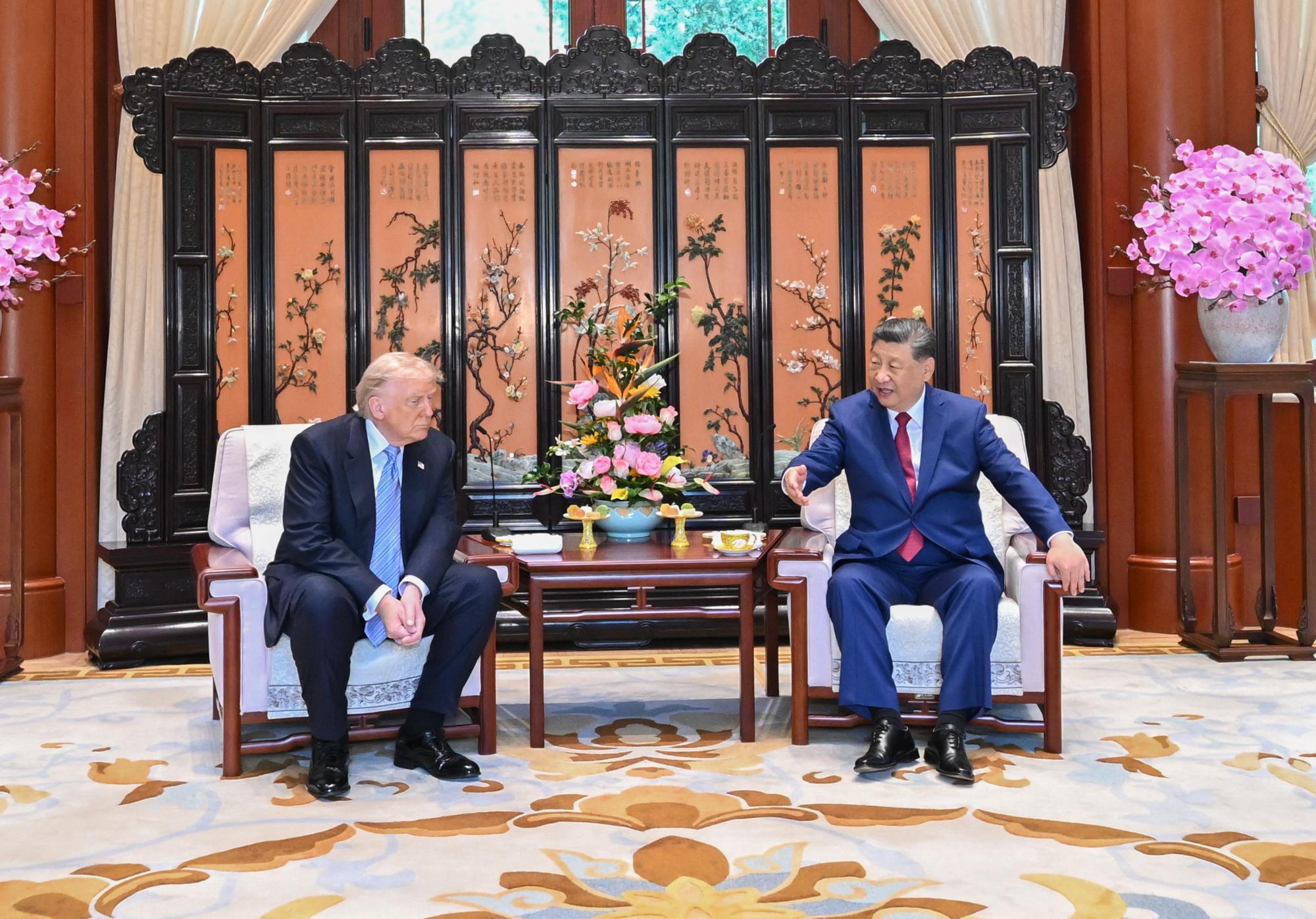
Donald Trump’s trip to Beijing marks the first formal visit to China by a U.S. president in nearly a decade. Since the last such visit, the balance between the United States and China in terms of comprehensive national power, global order, and geopolitical influence has undergone profound change. Compared with Trump’s first term, the Trump 2.0 administration continues to display a pragmatic and transactional orientation, but it has also become more aggressive and unpredictable. At the same time, Trump faces growing domestic constraints, while China’s capacity for countermeasures has expanded substantially.
On the eve of Trump’s visit, a U.S. trade court ruled that his 10 percent global tariff was illegal, limiting his ability to use tariffs unilaterally while bypassing Congress. Meanwhile, implementation of his trade agreement with the European Union has encountered obstacles, forcing him to accelerate the timeline to before July 4 in order to accumulate bargaining leverage. The war with Iran not only delayed his visit to China at one point, but is also certain to run through the agenda of the trip. For these reasons, mainstream U.S. media have generally argued that Trump does not enter this visit from a position of clear advantage.
I. A Persistent Transactional Logic, but a Changed Issue Agenda
Unlike traditional American politicians, who tend to foreground Western values as a central component of foreign policy, Trump is more focused on concrete transactional outcomes. From Washington’s perspective, Iran and energy security are priority issues. U.S. Treasury Secretary Scott Bessent has explicitly identified Iran as the top agenda item, directly targeting China’s oil trade with Iran and imposing related sanctions. Secretary of State Marco Rubio has also publicly called on China to encourage Iran to loosen its control over the Strait of Hormuz. Trump’s ally, Republican Senator Steve Daines, raised the same issue during his May 7 visit to China.
A second U.S. priority concerns illegal immigration and counternarcotics cooperation, both of which are closely connected to Trump’s political base and Republican prospects in the midterm elections. Around last year’s Busan summit, China and the United States had already cooperated on efforts to combat sources of fentanyl and other narcotics. This time, Washington hopes to further strengthen such cooperation while accelerating the repatriation of Chinese nationals residing illegally in the United States.
From Beijing’s perspective, Taiwan remains the core red line. Rubio has acknowledged that Taiwan will be discussed during the visit. China hopes the United States will oppose Taiwan independence and exercise restraint on arms sales to Taiwan. Within the U.S. policy establishment, however, there is little willingness to abandon support for Taiwan, nor is there much appetite for Trump to make an explicit statement opposing “Taiwan independence.”
Technology and artificial intelligence constitute another major area of Chinese concern. Beijing is expected to continue pressing Washington to relax export controls and to pursue cooperation on AI governance. Potential areas of discussion include managing abnormal model behavior, autonomous military systems, and the risks posed by non-state actors and individuals misusing open-source AI tools. According to The Wall Street Journal, as the two most important actors in global AI governance, China and the United States are both interested in establishing regular dialogue mechanisms.
In the economic and trade domain, the most likely deliverables from Trump’s visit include an extension of the current trade truce, Chinese purchases of U.S. soybeans and other agricultural products, and a major Boeing aircraft deal. If such agreements are finalized, they will likely be presented by Trump as major achievements of the visit.
The two sides may also seek limited consensus on global issues such as the Russia–Ukraine war, the Israeli–Palestinian conflict, and nuclear security. Chinese Foreign Ministry spokesperson Guo Jiakun stated at a regular press conference on the 11th that the two leaders would conduct in-depth exchanges on “major issues concerning China–U.S. relations and world peace and development.” He added that China is willing to work with the United States “in the spirit of equality, respect, and mutual benefit, to expand cooperation, manage differences, and inject more stability and certainty into a turbulent world.”
II. Bargaining Chips and Countermeasures
To achieve these short-term objectives, Trump’s team has been actively searching for new bargaining chips. On the issue of illegal immigration and repatriation, officials from the Department of Homeland Security have suggested that China has slowed its cooperation. They have warned that, unless Beijing accelerates the process, Washington may expand visa restrictions on relevant Chinese personnel. In this sense, immigration has become another lever of pressure in U.S. policy toward China.
Among the current bargaining tools available to Washington, Iran-related oil trade is the central instrument. Trump’s team has been preparing this issue well in advance. Before Trump’s arrival in Beijing, Bessent held consultations in South Korea with Chinese Vice Premier He Lifeng. A week earlier, the two had also held a video call. Both exchanges were connected to U.S. sanctions on Chinese oil companies and China’s corresponding countermeasures. Xinhua’s readout of the video call noted that China had expressed serious concern over recent U.S. economic and trade restrictions targeting China. However, both sides agreed to continue making use of the China–U.S. economic and trade consultation mechanism, “continuously increase consensus, manage differences, and strengthen cooperation.”
Since Trump’s first term, the American right has urged Washington to sanction countries that engage in oil trade with Iran. Shortly after Trump returned to office last year, the U.S. Treasury Department’s Office of Foreign Assets Control placed a number of Chinese private enterprises, including Shandong Shouguang Luqing Petrochemical, Shandong Jincheng Petrochemical, and Hebei Xinhai Chemical, on the Specially Designated Nationals list. In April this year, the United States launched an “economic fury” campaign against Iran and used oil trade as a basis for escalating sanctions on China, targeting companies such as Hengli Petrochemical, roughly 40 vessels, and associated shipping firms. Washington also warned financial institutions of the risks of conducting transactions with these entities.
In response, China’s Ministry of Commerce issued a blocking order on May 2 against illegal unilateral U.S. sanctions, requiring Chinese enterprises and individuals not to recognize, implement, or comply with such measures. This sent a clear signal: Washington cannot compel China into compliance through sanctions, and Beijing will not tolerate U.S. efforts to manufacture leverage immediately before a summit. This was China’s first systematic use of legal instruments to counter U.S. long-arm jurisdiction. Following China’s reciprocal tariff countermeasures in 2025 and its rare earth controls, the blocking order represents another example of Beijing’s more proactive use of policy tools.
On April 27, China’s National Development and Reform Commission, acting under the Measures for the Security Review of Foreign Investment, prohibited Meta from acquiring the Chinese AI start-up Manus and required the transaction to be unwound. This was the first publicly halted wholly foreign-owned acquisition in the AI sector since the implementation of the review mechanism, underscoring Beijing’s uncompromising posture in core technology sectors. In the past, the United States used its Entity List and CFIUS investment review process to intensify technological competition with China. China is now increasingly using similar logic to counter U.S. pressure.
China has thus become more proactive in deploying geopolitical and legal tools. It is no longer merely responding defensively, as it often did in the past. The current interaction increasingly reflects a contest between the two countries’ legal, sanctions, and counter-sanctions systems.
III. Dialogue as an Outcome: Stability as the Central Objective
The ultimate purpose of Trump’s effort to manufacture bargaining leverage is to reach deals. For example, he hopes that Asian countries such as China, Japan, and South Korea, all of which rely heavily on oil imports through the Strait of Hormuz, will increase purchases of U.S. oil. Regarding China’s first blocking order against U.S. sanctions, U.S. Trade Representative Jamieson Greer stated that Washington did not want the measure to damage the broader bilateral relationship and that the United States sought to maintain “stable” relations with China.
According to a list provided by the White House to the media, the U.S. corporate executives accompanying Trump include Tesla’s Elon Musk, Apple CEO Tim Cook, Nvidia CEO Jensen Huang, Boeing CEO Kelly Ortberg, and senior executives from Goldman Sachs, Blackstone, Citigroup, and other major corporations. The presence of these executives indicates that Trump hopes the visit will facilitate a series of commercial deals and procurement agreements.
Overall, external expectations for the visit remain modest. When the trip was postponed a month earlier due to the war with Iran, even officials in Washington reportedly lacked clarity about Trump’s concrete objectives for the visit. No advance team of senior aides had been sent to prepare the ground. The main reason was the absence of effective leverage.
When Trump first visited China in 2017, China was still more constrained by U.S. advantages in trade and technology. Today, China has become a global manufacturing powerhouse and has made significant progress in electric vehicles, solar energy, artificial intelligence, and other advanced sectors. In particular, China holds major advantages in rare earth supply chains, giving it effective leverage over the United States. To be sure, China still faces weaknesses in a few areas, especially high-end semiconductors, and it continues to require stable export markets and technological inputs. The United States, meanwhile, still enjoys advantages in finance and high technology. This complementarity is precisely the basis for continued dialogue.
Trump’s transactionalism creates room for cooperation on selected issues. China, for its part, hopes to use the visit to increase certainty and stability in bilateral relations. In an international environment where rules are increasingly giving way to power politics, the United States often shifts toward pragmatic compromise after applying pressure. Even during the Cold War, confrontation between the United States and the Soviet Union did not prevent cooperation in areas such as arms control, space, and disease prevention. The degree of economic interdependence and interest integration between China and the United States is far greater than that between Washington and Moscow during the Cold War. To manage competition, prevent miscalculation, and avoid escalation, both sides need to maintain dialogue and stable interaction. This is the practical significance of Trump’s insistence on visiting China and of Beijing’s willingness to engage actively.
Related Reads for You
Discover more research and analysis on topics shaping the Indo-Pacific.